
The 11 R's of Circularity: A Framework for Schools That Actually Changes Behaviour
How circular thinking, LEAN principles, and neuroscience are transforming the way our participants engage with climate action
There's a quiet revolution happening in schools. It doesn't look like a protest or a policy. It looks like someone noticing a broken chair and asking, "Can we fix that instead of throwing it away?" It looks like a class mapping out where their waste goes. It looks like young people who don't just know about climate action — they're doing something about it.
This is the heart of the Climate Action Schools program: equipping participants with the thinking tools to create real, lasting change. And at the centre of that toolkit sits a deceptively powerful framework — the 11 R's of Circularity.
What is the circular economy?
Our current economy largely follows a straight line: take, make, dispose. Resources are extracted, products are manufactured, and waste is generated. The circular economy challenges that model entirely.
Instead of a line, think of a loop — where materials stay in use for as long as possible, waste is designed out of the system, and natural systems are regenerated rather than depleted.
The 11 R's give us a practical vocabulary for navigating that loop.
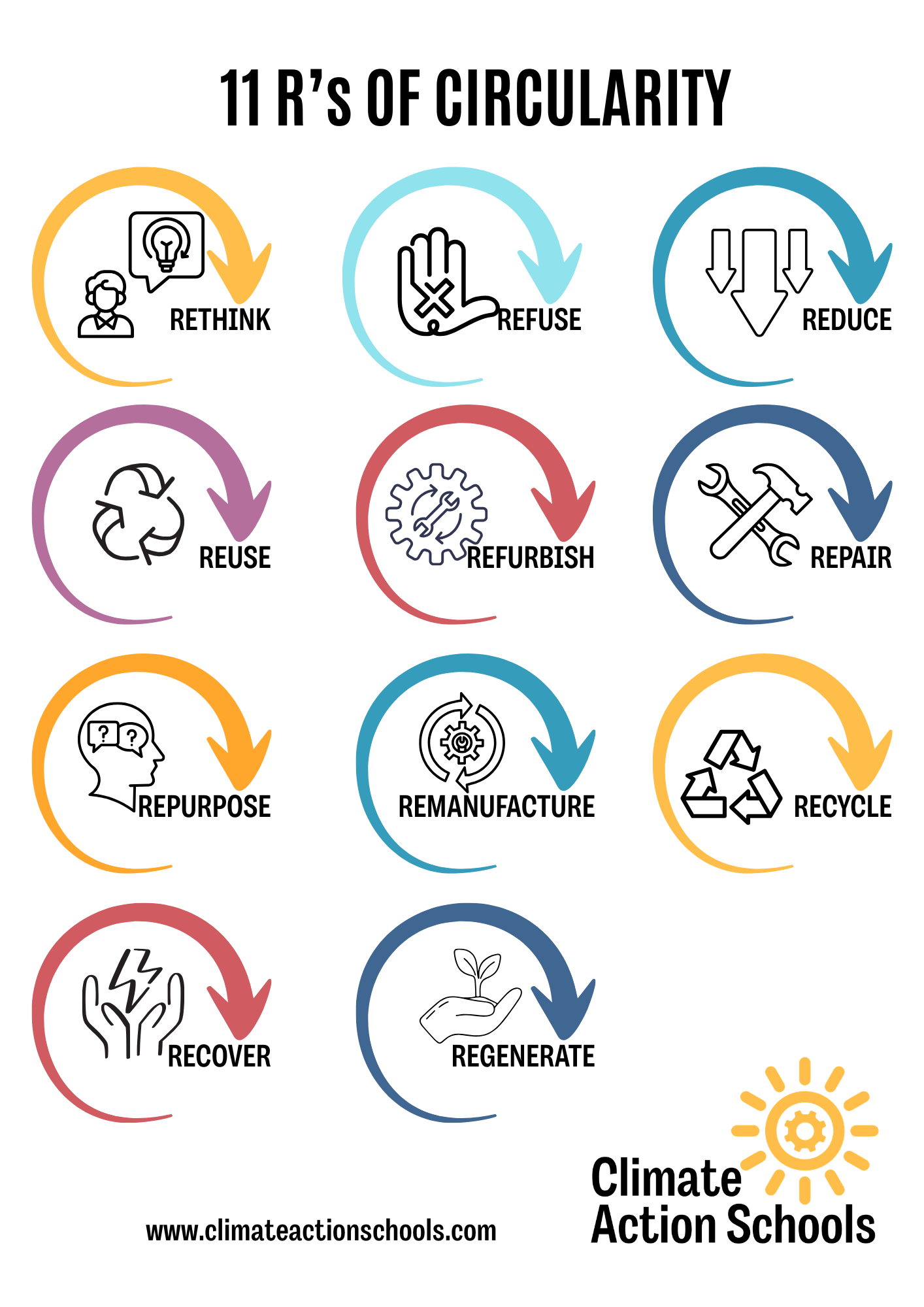
The 11 R's — and why the order matters
These aren't just a list of good ideas. They form a hierarchy, moving from the most impactful interventions (preventing waste before it's created) to the least (recovering energy from what's left). The further up the list you act, the greater the benefit.
1. 🔄 Rethink Before anything else, question the system itself. Do we need this product? Is there a smarter way to meet this need? Rethinking is where innovation begins.
2. ❌ Refuse The most powerful R. If something adds no value, don't accept it in the first place. Single-use packaging, unnecessary materials, low-quality items designed to fail — refuse them.
3. 📉 Reduce Use less. Buy less. Consume less. Reducing the volume of materials entering the system is one of the most direct ways to lower environmental impact.
4. ♻️ Reuse Before discarding something, ask whether it can be used again — by you or someone else — in its current form.
5. 🔧 Repair Fix what's broken rather than replacing it. Repair culture is one of the most underrated forces in sustainability.
6. 🔁 Repurpose Give something a new function. A pallet becomes a garden bed. A glass jar becomes a pencil holder. Repurposing extends the life of materials creatively.
7. 🏭 Remanufacture Disassemble products and use their components to build something new to the original specification. Common in electronics and automotive industries.
8. 🛠️ Refurbish Restore a product to good working condition — often better than its previous state — without full disassembly.
9. 🌱 Renew Restore natural systems and regenerate resources. This goes beyond sustainability into active healing of ecosystems.
10. ♻️ Recycle Break materials down and use them as raw inputs for new products. Important — but note that recycling sits near the bottom of the hierarchy. It's a last resort, not a first response.
11. 🔥 Recover Extract energy from waste that cannot be recycled. The final option before landfill.
Where Functional Sustainability (LEAN) comes in
LEAN thinking has a simple, elegant purpose: eliminate what adds no value and continuously improve what does.
That phrase is worth sitting with. Eliminate what adds no value. Continuously improve what does.
Sound familiar? It's essentially the circular economy in operational language.
LEAN identifies eight classic forms of waste — overproduction, waiting, unnecessary transport, over-processing, excess inventory, unnecessary motion, defects, and unused talent. When you map these against the 11 R's, the overlap is striking.
Refuse and Reduce mirror LEAN's drive to eliminate overproduction and excess inventory
Repair and Refurbish align with LEAN's focus on reducing defects and rework
Repurpose and Remanufacture reflect LEAN's principle of maximising the value already embedded in materials and processes
Rethink is the LEAN kaizen mindset — continuous questioning, continuous improvement
In a school context, LEAN gives participants a systems lens. They're not just sorting recycling bins. They're mapping value streams, identifying waste, and designing better processes. That's a genuinely transferable skill.
Where neuroscience enters the picture
Here's the challenge with sustainability education: knowing about climate change doesn't automatically change behaviour. If it did, we'd have solved this decades ago.
This is where understanding the brain becomes essential.
Lasting behavioural change requires more than information. It requires psychological safety (people need to feel they belong and won't be judged for trying), emotional connection (the issue has to feel personally relevant), clear goals (people need to know what success looks like), social reinforcement (change sticks when it's shared), and hope (without a believable vision of a better future, action feels pointless).
The Climate Action Schools program is designed with all of this in mind. Participants aren't lectured at — they're engaged. They're not given answers — they're given tools to find their own. The 11 R's become a shared language that builds identity and belonging around positive action.
When a participant says "we refuse single-use plastics in our canteen now" — that's not just an environmental win. That's a participant who has experienced the satisfaction of making a real difference. That experience rewires how they see themselves and what they believe is possible.
What this looks like in practice
Imagine a school that runs a Circular Audit — students map every material that enters and leaves the school over a week. Using LEAN tools, they identify the biggest sources of waste. Using the 11 R's hierarchy, they prioritise interventions. Using an understanding of human behaviour, they design campaigns that shift habits.
The results aren't hypothetical. Schools that engage in this kind of structured, systems-based climate action see:
Measurable reductions in waste
Increased participant agency and wellbeing
Staff who feel part of something meaningful
Communities that extend the learning beyond the school gate
The bigger picture
The 11 R's of Circularity aren't just an environmental framework. They're a way of thinking — about value, about systems, about what we choose to accept and what we choose to change.
When combined with the continuous improvement discipline of LEAN and the behavioural insight of neuroscience, they become something genuinely powerful: a practical, human-centred approach to one of the defining challenges of our time.
And it turns out, schools are exactly the right place to start.
The Climate Action Schools program supports participants to build the knowledge, skills, and mindsets needed for real climate action — from the classroom to the community.