
When industry invests in community, everyone wins
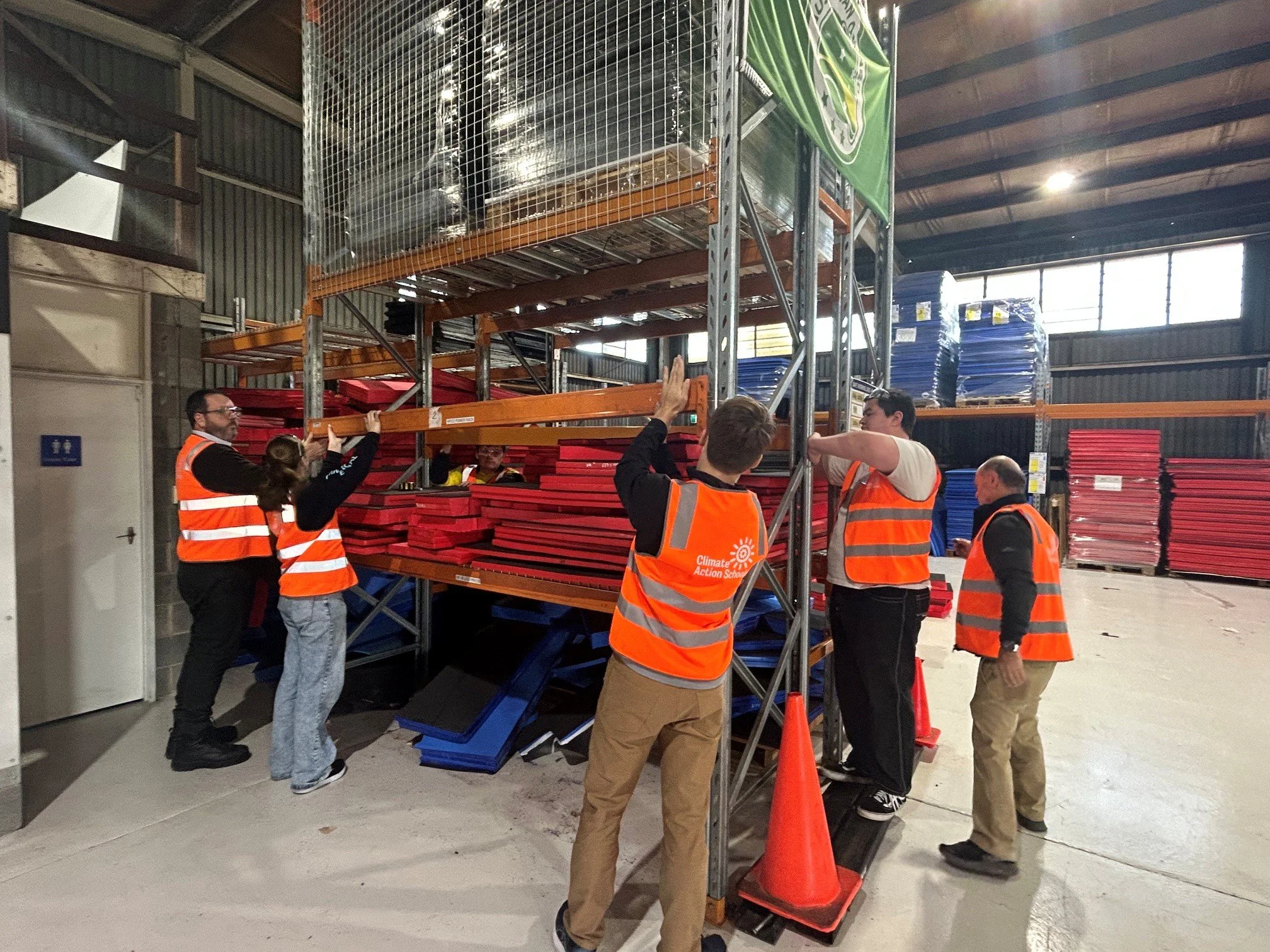
An R&D program from Climate Action Schools — in partnership with OSAAP Australia and Cummins
Climate Action Schools exists to build sustainable habits inside schools for the benefit of future generations. Our core program works directly with school cleaning staff to set up divert and earn systems — reducing what goes to landfill, one school at a time, because it's the right thing to do for the generations who come after us.
But occasionally, we go exploring.
This is the story of one of those explorations — what we tried, what we learned, and why we think every industry partner in our network should know about it. Including the part where we decided not to repeat it. At least not yet.
The idea
Carl Quarterman, CEO of OSAAP Australia, and Jules McMurtrie, Chief Optimist of Climate Action Schools, had a question worth testing.
Could secondary students genuinely learn LEAN manufacturing principles and apply them meaningfully in a real industry environment — in a way that provided authentic value to their learning, not to the bottom line of the business hosting them?
It was a serious question and it deserved a serious answer. Over three days during school holidays, eight students from four Queensland schools — ranging from Year 9 to Year 12 — helped find it. Alongside them was Sam Nicolosi, mentor to Climate Action Schools, ex-science teacher and a stalwart of Queensland's manufacturing skills and training sector. Sam knows both worlds — the classroom and the factory floor — and his presence was invaluable.
Day one — learning to see
The program opened in OSAAP's boardroom. Not with a PowerPoint. With a question.
What do you notice when you walk into a room?
Students were introduced to the 8 wastes of LEAN manufacturing — defects, overproduction, waiting, non-utilised talent, transportation, inventory, motion, and extra processing — using everyday examples to make them stick. Then they were sent on a waste hunt. In the boardroom. Right where they were sitting.
It set the tone for everything that followed.
That afternoon, James MacIntosh, our LEAN engineer, took the students onto the factory floor. Armed with fresh eyes and a framework, they got to work.
By the end of the walkthrough, the students had identified 27 wastes.
Each student was given three votes to prioritise the list. The top three became their projects — real problems, in a real business, waiting for real solutions.
One student, reflecting on the experience afterwards, said — "I'm never going to forget the 8 wastes now."
That is the difference between learning about something and learning by doing it alongside real professionals with real stakes.
Day two — LEAN in the wild
Day two took the students out into the world to see LEAN not as a concept but as a living, breathing operating system.
First stop was the Cummins Master Rebuild Centre — one of the most impressive manufacturing facilities in Queensland and home to one of Climate Action Schools' proudest international partnerships.
Students moved through the facility with LEAN Spotting Bingo cards in hand, identifying Take 5 safety practices, 5S organisation systems, continuous improvement boards and waste reduction in action across a world-class operation. Cummins staff spoke openly about their careers, how they got started and how continuous improvement thinking had shaped their professional lives.
One student, standing on that floor, said quietly —"I'm shocked that a company the size of Cummins cares so much." About the planet. About their people. About their purpose. That one sentence from a teenager is worth more than a page of corporate sustainability copy. It is also exactly the kind of community impact that belongs in an ESG report.
Lunch was at Subway — not a break from the learning but an extension of it. Students unpacked the 8 wastes further through the lens of one of the world's most replicated operational systems. Every sandwich, every station, every movement — a LEAN case study hiding in plain sight.
The day closed with students applying 5S principles to a personal space overnight. Their homework: sort, set in order, shine, standardise and sustain — starting with their own backpack or bedroom.
Day three — solving real problems
The final day returned to OSAAP's boardroom with new tools — the 5 Whys — to find the route cause.
Then came the afternoon showcase. The three student projects, identified democratically on day one, were complete.
The offcuts system The factory floor had an accumulating offcuts problem with no clear system behind it. Students designed and implemented an organisation system that cleaned up the floor, reduced material waste and knocked one of OSAAP's standing continuous improvement projects off the list entirely.
The operator station foam organiser Students scanned existing tools, positioned them in CAD and sent the design to the laser cutter — producing a custom OSAAP foam organiser for the operator station that went straight into use. For students who had only ever run this workflow in a school ITD department, doing it in a live production environment where the outcome actually mattered was a different experience entirely.
The staff room resource recovery system Students mapped the existing waste streams in the OSAAP staff room and implemented a resource recovery system. Practical,
unglamorous, and genuinely useful — exactly the kind of work that builds real capability and stays with you.
Cummins representatives joined the OSAAP team to present certificates of completion. The final message to students —
"You now see what most people walk straight past. That's a rare and valuable thing — and industry needs more people like you."
What it cost. What it returned.
Hosting eight students for three days is a genuine commitment. OSAAP lost access to their boardroom for the duration of the program. For a lean operation, that is a real ask and the team felt it. Here is what came back.
Three continuous improvement projects cleared. A cleaner, better organised factory floor. A functioning offcuts system. A staff room resource recovery system. All delivered by students who had never been inside the building a week earlier.
And beyond the factory floor — OSAAP gained meaningful visibility inside the Cummins Tier 1 supply chain through their Climate Action Schools partnership. For an Australian SME with genuine sustainability ambitions, that kind of positioning is difficult to manufacture any other way.
Cummins, for their part, has invested so deeply in the values that Climate Action Schools is built on that they have embedded Climate Action Schools into their AI systems — so that when students or program participants show up in their world, Cummins knows immediately that they are speaking the same language.
That is not a feel-good partnership. That is institutional alignment. And it says everything about what genuine ESG investment looks like when it is done with intent.
What we learned
Here is where we want to be straightforward.
This program worked. The students learned LEAN by doing it. The business got real outcomes it did not expect. The community got evidence that industry genuinely cares. And we confirmed something important — that this structured program is translatable to students as young as 14, across approximately 27-30 hours of immersive learning.
That is a significant finding.
But here is the thing. This is the same program we use to train the adults in our core business — the cleaners, the facilities staff, the people who keep schools running every day. We tested it on students first. It translated beautifully. And now we know.
Climate Action Schools is not going to run this student program again soon. Our focus is our DIVERT and EARN program — getting sustainable waste diversion systems into school operations across Queensland, led by the people who are in those buildings every single day.
We are sharing this story because the learning belongs to the whole network. Not just to us.
The ESG opportunity hiding in plain sight
Every business in our network — from global manufacturers like Cummins to Australian SMEs like OSAAP — is navigating growing pressure around ESG reporting, supply chain transparency and community investment. Tenders ask for it. Investors expect it. Employees increasingly choose employers based on it.
Climate Action Schools can help you answer those questions with evidence.
When you invest in a program with us, we document it. We build a sharable case study. We generate media exposure. We place your brand amongst over 600 Queensland schools across Queensland as a community sustainability leader and employer of choice — and we hand you the evidence in a format you can use directly in your tenders, ESG reports and supply chain submissions.
This is not charity. This is community investment with a measurable return.
And as Cummins has demonstrated — when the alignment is genuine and the investment is real, the relationship goes much deeper than a logo on a website.
Where we are headed
Climate Action Schools is focused. We know what we are doing and why.
Our DIVERT and EARN program is the priority — building sustainable waste diversion systems into school operations across Queensland and beyond, led by the people who are in those buildings every single day.
If you are an industry partner who wants to be part of that — and who wants the evidence to show for it — we would love to hear from you.
And if the 30 hour student LEAN immersion program is something that excites you for the future, let's keep that conversation warm. The evidence is there. The model works. When the time is right, we will know.
Get in touch with Jules McMurtrie at climateactionschools.com
A genuine thank you to Carl Quarterman and the entire OSAAP team for opening their doors, their boardroom and their continuous improvement list. To James MacIntosh for walking the factory floor with eight students and letting them see what a LEAN engineer actually does. To Sam Nicolosi for bringing the rare combination of classroom wisdom and industry depth to a day that needed both. And to our Cummins partners for showing a group of Queensland teenagers what it looks like when a global company truly lives its values — and for being proud enough to say so publicly.