
From VUCA to BANI: Why schools need a new map for a changing world
The world just got harder to read — and young people need to know why.
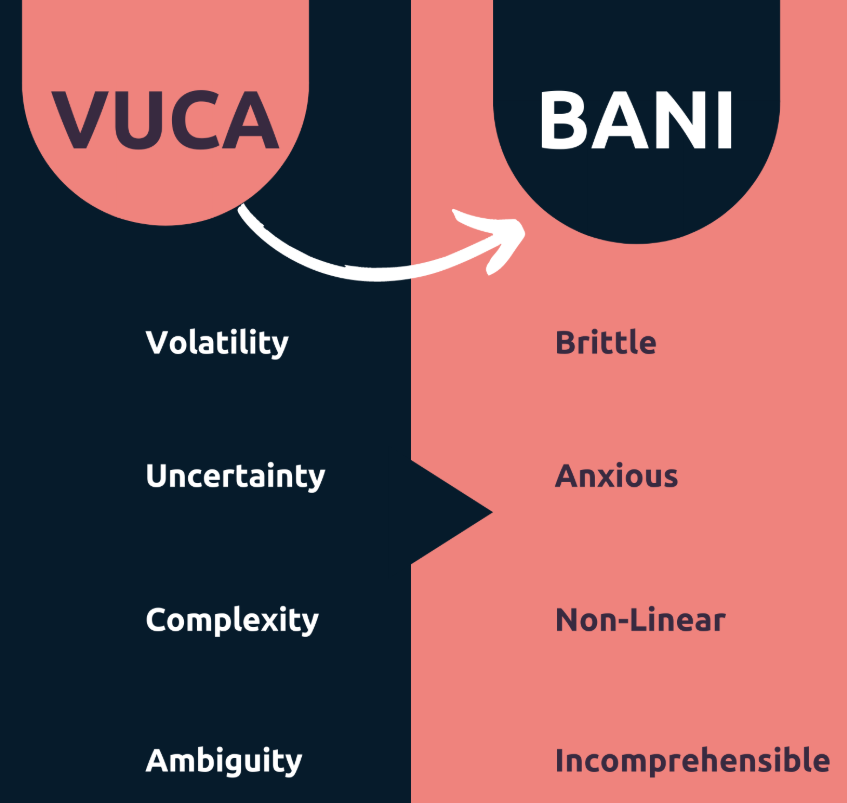
For decades, leaders described uncertainty using four letters: VUCA. Volatile. Uncertain. Complex. Ambiguous. It came from military strategy, moved into business, and eventually shaped the way many organisations thought about change.
It was useful. Until it wasn’t.
When the old map stops working
VUCA described a world that was difficult, but still readable.
Volatility could be tracked.
Uncertainty could be managed.
Complexity could be mapped.
Ambiguity could, with enough analysis, be resolved.
But the world has shifted.
A pandemic shut down global supply chains overnight. Climate impacts began arriving faster than expected. Ecosystems started tipping, not slowly, but suddenly. AI began reshaping industries in months, not decades.
VUCA did not fail because it was wrong.
It failed because the world outgrew it.
Enter BANI
Futurist Jamais Cascio introduced a new framework: BANI.
It offers a more honest way of describing the world many young people are growing up in now:
Brittle — systems can appear stable, until they suddenly break.
Anxious — uncertainty is no longer just strategic; it is emotional.
Non-linear — small actions can have outsized, unpredictable effects.
Incomprehensible — we are generating more information than we can meaningfully process.
This is not just a language shift. It is a signal that the nature of disruption has changed — and the skills we need must change too.
Why this matters for schools
Here is the uncomfortable truth: much of education was designed for a world that felt more predictable than the one students are now entering.
Memorise. Recall. Apply. Follow the process. Find the right answer.
But a BANI world does not always offer neat answers. It asks people to navigate trade-offs, unintended consequences, feedback loops, and ethical complexity.
The young people sitting in classrooms today will inherit a world shaped by climate change, rapid technological change, social disruption, and systems that are more interconnected than ever.
They will need more than knowledge.
They will need judgment, adaptability, and the ability to think in systems.
Why systems thinking matters more than ever
Systems thinking helps young people look beyond isolated events and start noticing patterns, relationships, and consequences.
It encourages them to ask:
What is happening here?
What is driving it?
What happens if one part changes?
Who or what is affected?
These are not just useful learning habits. In a brittle, non-linear world, they are practical life skills.
Sustainability education strengthens this even further. It helps students think beyond the immediate, weigh long-term consequences, and understand how environmental, social, and economic systems are connected.
This is not abstract idealism.
It is preparation for the world they are actually entering.
The emotional side of a BANI world
One of the most important things BANI brings forward is the human experience of uncertainty.
Anxiety is not simply a weakness to overcome. In many cases, it is a rational response to fragility, change, and overload.
But anxiety without tools can turn into paralysis.
What young people need is not false reassurance. They need opportunities to build confidence, agency, and the capacity to engage with complexity honestly.
What Climate Action Schools is doing differently
This is why programmes like Climate Action Schools matter.
Climate Action Schools is not just teaching students about recycling, waste, or carbon footprints. It is helping them build the mindset and capabilities needed to participate in a changing world.
Through practical projects, systems thinking, sustainability, and industry-connected learning, students begin to see that they can understand systems, influence outcomes, and play a role in shaping what comes next.
That matters.
Because when young people move from the world is broken and I am powerless to I can understand this, and I have a role to play, something shifts.
That shift is not just educational.
It is transformational.
A new foundation for learning
The move from VUCA to BANI tells us something important:
We cannot prepare young people for today’s world using yesterday’s map.
Sustainability and systems thinking are not add-ons. They are becoming part of what it means to be an informed, capable, and ethical human in the 21st century.
And in a world that is increasingly brittle, anxious, non-linear, and incomprehensible, that matters more than ever.
To learn more about Climate Action Schools and how your school can get involved, visit climateactionschools.com