
Curriculum Alignment Validation: Climate Action Schools Sustainability Skills Centre (SSC)
Where sustainability stops being a concept — and becomes a hands-on, industry-aligned learning experience.
Program Snapshot: Why the SSC Changes the Game
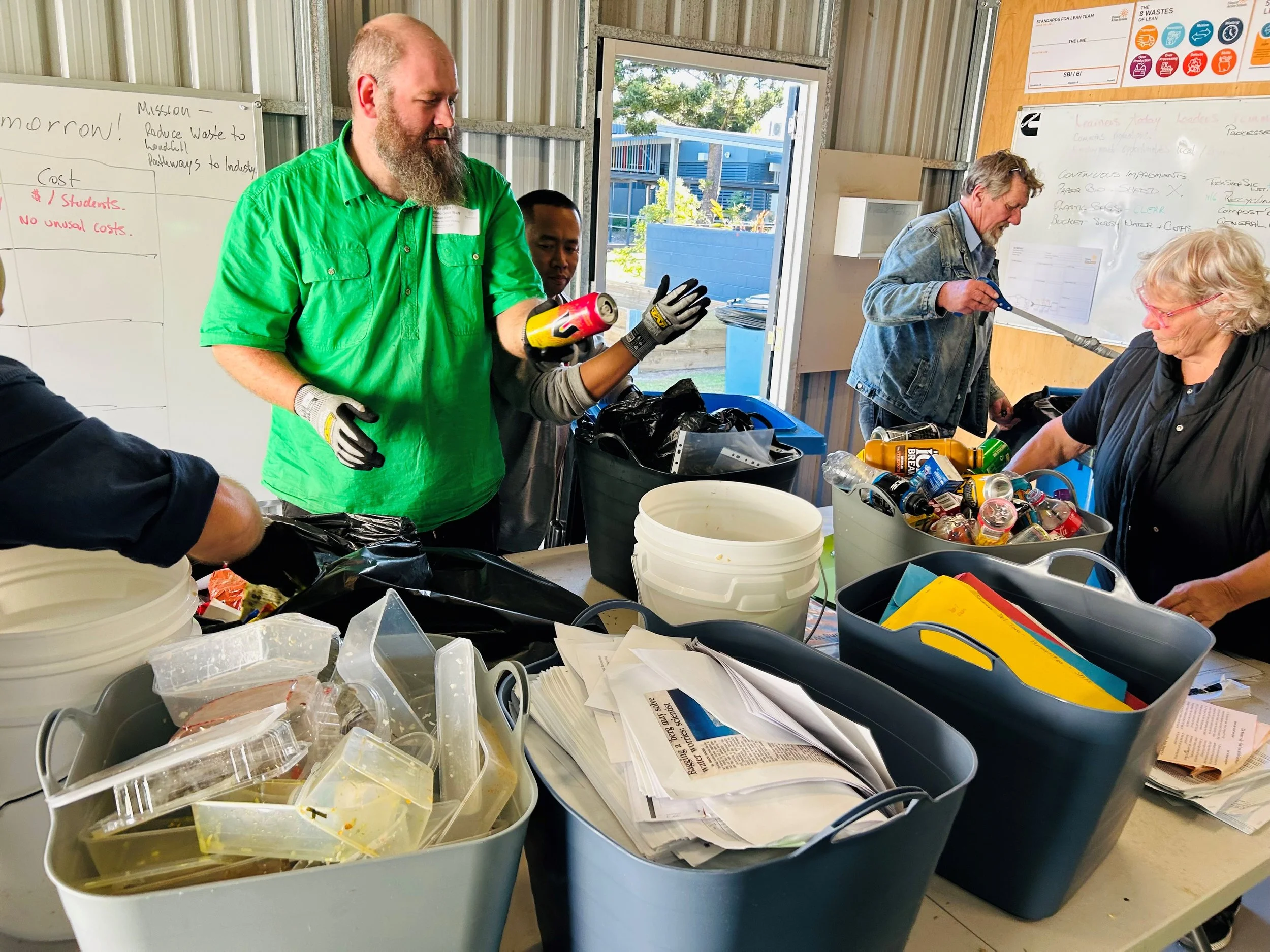
The Climate Action Schools Sustainability Skills Centre (SSC) turns your school’s waste stream into a working, industry-style learning environment. Students don’t just learn sustainability — they operate it.
Across a 5S-organised, LEAN-inspired, real-world setup, students audit, sort, analyse, and divert materials using the same functional sustainability practices used in modern workplaces. Every activity builds capability in:
✔ Resource recovery
✔ Circular economy thinking
✔ ESG awareness
✔ Data collection & analysis
✔ Problem-solving + continuous improvement
✔ VET competencies and employability skills
This is sustainability students can see, touch, measure, and improve — all while delivering strong cross-curriculum outcomes.
How the SSC Powers Your Teaching
The SSC creates a ready-to-go practical context that plugs directly into ACARA V9 for Years 7–12, strengthens General Capabilities, and provides real evidence for QCAA/VET competencies.
Below is a streamlined, exciting version that principals and teachers can skim quickly and feel confident with.


1. ACARA Version 9 — Direct Curriculum Alignment (Cross-Curriculum Priorities)
Sustainability (Core Alignment)
Students actively engage with the environmental, social, and economic sides of sustainability — not through worksheets, but real-world action: waste diversion, cost saving, and community benefit. They see sustainability as operational, not theoretical.
Aboriginal & Torres Strait Islander Histories and Cultures
The SSC opens conversation about caring for Country, Indigenous land stewardship, and long-term resource relationships — and how these perspectives enrich modern sustainability practice.
Learning Areas & Examples of Alignment:
SCIENCE
Students explore materials, ecosystems, cycles, impacts, and data — all embedded into their SSC tasks.
In Practice:
Classifying materials through sorting processes
Investigating why items can or can’t be recycled
Comparing landfill impact vs resource recovery
Running waste audits as scientific investigations
Using 5 Whys/Fishbone for environmental inquiry
Achievement:
Students demonstrate scientific inquiry, analyse data, and interpret results connected to real environmental systems.


MATHEMATICS
The SSC is a numbers goldmine: measurement, percentages, ratios, data interpretation, costs, revenue and trends.
In Practice:
Weighing/ measuring waste streams
Calculating diversion rates and contamination
Tracking cost savings
Building spreadsheets and graphs
Identifying inefficiencies using 8 Wastes
Achievement:
Students apply numeracy in a real workplace context, solving meaningful sustainability and financial problems.
TECHNOLOGIES (Design & Technologies)
A living systems lesson: materials, lifecycle thinking, system improvements, and design processes.
In Practice:
Mapping the school waste system
Diagnosing inefficiencies with 8 Wastes
Redesigning SSC layouts using 5S
Creating SOPs
Evaluating the sustainability of processes
Achievement:
Students use design thinking, evaluate systems, and implement improvements with genuine impact.


DIGITAL TECHNOLOGIES
Real data. Real dashboards. Real decisions.
In Practice:
Recording data digitally
Creating graphs for Visual Management Boards
Digital SOPs and process mapping
Using apps for checks/audits
Achievement:
Students apply data skills, digital literacy, and real workplace systems.
HASS (Geography, Economics & Business)
In Practice:
Exploring economic value of “waste as resource”
Conducting cost–benefit analysis of diversion
Discussing global waste systems and justice
Linking resource recovery to circular economy models
Achievement:
Students understand environmental, social, and economic connections with a global lens.
General Capabilities Strengthened Through SSC
Critical & Creative Thinking: Root cause analysis (5 Whys, Fishbone), systems improvement
Numeracy & Literacy: Real documentation, data recording, reporting
ICT Capability: Digital data management
Personal & Social Capability: Team ops, communication, safe work practices
Ethical Understanding: Environmental responsibility & social impact
Intercultural Understanding: Country, stewardship & sustainability knowledge
QCAA VET Qualification Alignment
The SSC provides authentic evidence for VET units — no simulated activity required.
MSM21615 Cert II in Manufacturing Technology
Direct alignment with:
Apply competitive systems and practices (LEAN)
Apply safety (Take 5)
Apply quality systems (5S, defect identification)
Participate in a team
Apply minimum waste processes (8 Wastes)
Continuous improvement (5 Whys, Fishbone)
Data, charts, and workplace diagrams
BSBSUS211 — Environmentally Sustainable Work Practices
Authentic application through resource recovery, waste diversion, environmental hazard identification, and improvement actions.
BSB20120 Cert II in Business
WHS
Teamwork
Task management
TLI21616 Cert II in Warehousing Operations
Sorting, receiving, processing, documentation, safety.
SHB10121 Certificate I in Volunteering
Teamwork, communication, safe operations — naturally embedded in SSC student roles.
Conclusion
The Sustainability Skills Centre is more than a recycling station.
It is a multi-disciplinary, industry-aligned learning ecosystem that:
✔ Meets ACARA V9 efficiently
✔ Builds General Capabilities naturally
✔ Generates real evidence for VET competencies
✔ Connects students to future career pathways
✔ Strengthens ESG partnerships with industry
✔ Turns abstract sustainability content into living, measurable, impactful learning
Your students don’t just learn about sustainability —
they operate it, measure it, improve it, and own it.